
Sources for Hurst Previous Residents
The backward trail behind a Hurst address is an evidence stack. Tarrant County’s deed-history cards give an explicit historical bridge, while the official real-property index, Archives series, library routes, and census schedules can fill different parts of the story. The dates in the table are only the ranges the research verified. A source family with an unknown Hurst span stays marked unknown, even when it may be worth checking for a particular address.
| Source | Years It Covers | Where Held | What It Shows |
|---|---|---|---|
| Tarrant deed-history cards | 1876-1984 | Tarrant County tax/property information | Ownership and property-history references that bridge to instruments |
| Tarrant Archives property ledgers | 1876-1917 | Tarrant County Archives | Historic property records and ledger entries |
| County Clerk property subseries | 1874-1958 | Tarrant County Archives collection | Deeds, mortgages, liens, bills of sale, and dedications |
| Tarrant Archives land ledgers | 1897-1908 and undated listed material | Tarrant County Archives | County land and transaction context, with scan and handwriting limits |
| City-directory routes | Hurst-specific years not verified | TSLAC, UNT, UT Briscoe, and HPL routes | Address and household leads after a volume’s coverage is verified |
| Federal census schedules | 1790-1950, subject to the federal release rule | Library and archive repositories | Household composition and place as enumerated |
For a recent transaction, begin with the parcel and recorded instrument. For an older gap, begin with the 1876-1984 card route or an Archives series. A directory, census, permit, obituary, or oral-history finding works best as a dated companion to the parcel record, not as a substitute for it.
Note: Hurst permit retention and a full historical public permit index were not verified, so request a specific address, date range, and record category if needed.
Hurst Parcel Records for Past Residents
Use the Tarrant County GIS Public Map Viewer to locate an address and compare the parcel geometry with the current account. Then check the Tarrant Appraisal District property search for the property record. The address is useful, but the legal description, account, subdivision, and instrument number are sturdier links when a street number changes or disappears from an older document.
The county tax search distinguishes an owner mailing address from a property location. Preserve both as separate fields. The location helps identify the parcel; a mailing field has a different purpose. If GIS, TAD, tax data, and a deed point to different descriptions or a possible parcel split, stop the person-level search until the parcel is reconciled.
Tracing Hurst Previous Residents Through Deeds
The Tarrant County Official Records Search supports grantor and grantee names, document type, instrument number, subdivision, and dates. Begin with the current parcel’s legal description and latest instrument. The county did not provide a verified single online deed-image cutoff in the research reviewed, so do not assume a missing online result means the chain ends.
- Capture the current parcel account, legal description, subdivision when shown, and the latest instrument reference.
- Search the current purchaser as grantee and confirm that the instrument’s legal description matches the parcel.
- Identify the seller, then search that person or entity as grantee to locate the earlier purchase record.
- Repeat backward, saving the instrument date, recording date, document type, grantor, grantee, number or volume and page, and any mismatch.
- When the index or image trail is incomplete, use the deed-history card and Archives routes, then request an official copy through the County Clerk’s documented channels.
- Grantor / grantee
- The grantor transfers an interest in an instrument. The grantee receives that interest.
- Chain of title
- The documented sequence of transfers connected by matching legal descriptions and instruments.
- Legal description
- The tract, lot, block, subdivision, or other formal parcel wording that can link records when a street address cannot.
The County Clerk’s real-property copy page describes in-person, online unofficial, online certified, and mail routes. It also says the office does not perform title or lien searches.
Hurst Deed Research for Past Residents
The County Clerk provides record access and copies, not a finished ownership analysis. Build the chain yourself from the instruments and make a simple sequence record. Keep an unresolved discrepancy visible instead of inserting an inferred owner. A forward check can help: search a grantee for a later deed, release, plat, dedication, or transfer that exposes a name variant, parcel split, or related tract.
If an older instrument uses a road, railroad, school, church, cemetery, or rural route instead of a street number, use Hurst history, plats, county maps, and the legal description to bridge it. The official Hurst history identifies Parker, Arwine, the railroad depot, and post-office terms as useful historical anchors. A modern address should remain a correlation field, not the sole proof of continuity.
Hurst Cards for Past Residents
Tarrant County’s deed-history-card information identifies cards for ownership and property history from 1876 through 1984. Use a card’s legal description, instrument references, and owner sequence as a bridge to the recorded deed index. It is an explicit historical lead, not a promise that every card or deed image is online. That bridge can place previous residents in the right ownership period before a household source is compared.
The Tarrant Archives collection map adds property series for 1876-1917, land material listed as undated and 1897-1908, and a County Clerk property subseries dated 1874-1958. These series can contain deeds, mortgages, liens, bills of sale, bond assignments, and land dedications. Read each as the record it is. A mortgage or chattel record may add transaction context but is not itself a deed.
Note: Handwritten ledger fields may require direct scan reading, and collection dates do not guarantee a complete online index for one Hurst parcel.
Hurst Address Gaps for Past Residents
Myth correction: an old street number is not automatically the same parcel. No verified Hurst street-renaming, renumbering, annexation, or E911 readdressing chronology was located in the research. There is also no verified Hurst-specific Sanborn map year or sheet. Do not attach a claimed map year or renumbering date to an address without a repository record that supports it.
Instead, compare the tract or lot wording, subdivision plat, GIS geometry, deed-history-card references, historic locality names, and landmarks. A document naming a school, church, railroad, cemetery, or rural route may still lead to a modern Hurst parcel. It needs a documented bridge. City growth, the 1903 railroad stop, the 1909 community name, the 1949 post office, and 1952 incorporation are useful search dates, not direct proof of an address match.
Hurst Household Records for Past Residents
Ownership is only one part of who lived here before. A deed identifies parties to an instrument. A city directory can identify an occupant or listed householder for a publication period. A census schedule can identify a household as enumerated. An oral-history account reflects memory. Label each result by its source role rather than treating every name as a prior resident.
Regional directory routes require special care because exact Hurst directory titles, publishers, and year runs remain unverified. The shelf and access rules for those volumes are covered under Hurst city directories; use a specific volume only after its title page or coverage text supports Hurst. A missing directory entry can reflect an irregular run, a move, a route omission, a neighboring label, or a householder-only listing.
- Place the directory publication date beside the deed or card sequence, keeping the printed street and locality form.
- Match the closest available census schedule and record the enumeration date rather than assuming the directory and census describe the same day.
- Compare surname spellings, initials, address forms, and household roles before joining the two sources.
- Use a death-index route, obituary lead, probate file, cemetery source, or Archives biographical file to investigate a disappearance only when dates align.
Tarrant County Fire and Marriage Ledgers
The March 29, 1876 Tarrant County courthouse fire destroyed many early records. The Archives genealogy material identifies Marriage Records volumes I-III for 1876-1901, while county research notes that pre-fire marriage material is mostly destroyed, with later transcribed or certified items possible where copies survived. This makes the early gap a documented records-history limit, not a reason to assume a family or address had no connection to the area.
A marriage ledger can connect people and dates around an address history, but it does not establish that either person lived at the parcel. The Tarrant Archives marriage-ledger page provides the scanned handwritten-license route beginning with 1875 and 1876 volumes.
The marriage-ledger source shows the Archives’ scan-based historical record access.
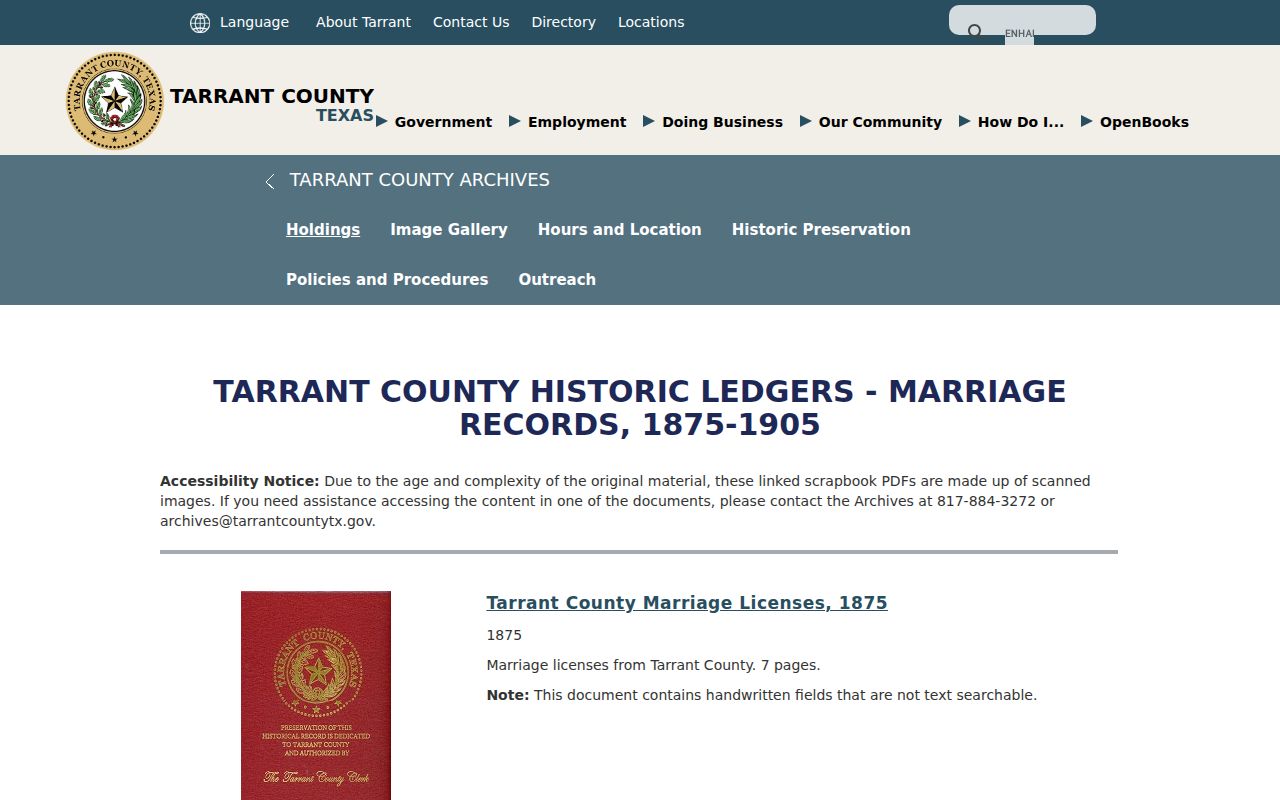
Use the ledger’s series, volume, page, and date with the deed sequence. The handwritten image should be checked directly before a name is copied into a research log.
Hurst Archive Leads for Past Residents
Hurst Public Library, the Northeast Campus Heritage Room, Tarrant Archives, oral-history material, cemetery sources, directories, deeds, plats, and newspapers can all contribute to a parcel history. The official Hurst resource page describes the Heritage Room as holding digital material on businesses, cemeteries, churches, courthouses, lawmen, monuments, outlaws, schools, Native Americans, and pioneers. Treat each as a lead whose date and source type must be recorded. The approach can also test a prior-resident lead without presenting a directory name as settled fact.
The Tarrant Archives has more than 600 collections and its genealogy holdings include named and biographical collections. Ask for the relevant series, a place name, an exact date range, or a confirmed instrument reference. The Archives does not hold all vital records and does not conduct general family-tree research, so use it alongside the County Clerk, library, and state routes rather than expecting one office to resolve every gap.
Hurst Privacy Limits for Past Residents
Past-resident research is best kept to family history, estate and heir questions, local history, and personal curiosity about a parcel. Deed images can contain signatures, mailing addresses, notary language, liens, releases, and other personal details. Record only what is needed to explain the instrument trail. A tax-account owner, a deed party, a directory householder, and an oral-history participant should never be collapsed into one blanket label.
When a current city-held permit, code, planning, or municipal record is needed, Hurst accepts written requests through its City Secretary public-information form. Ask for one address, category, and date range. The research did not verify a complete public historical permit search.